
Location
122 Hospital Road, Brush, Colorado 80723
Email Us
info@ebenezer-cares.org
Call Us
(970) 842-2861
122 Hospital Road, Brush, Colorado 80723
info@ebenezer-cares.org
(970) 842-2861
A Journey Through Time with Jens Madsen
In May of 1869, Jens Madsen was born in Fyn, Denmark. Perhaps it was this setting that inspired Rev. Madsen to study landscape architecture as this small island was christened "The Garden of Denmark" by Hans Christian Andersen. Fyn, the smaller of the country's two major islands, is dotted by beautiful beach glades and swan ponds.

In the spring of 1893, Madsen set sail for the United States and entered the Danish Lutheran Trinity Seminary in Blair, Nebraska. At that time, his fiancée, Ane Neilsen, moved to the States and worked at the home of Professor Vig in Chicago, Illinois, where Madsen would eventually come to attend seminary.
Rev. Madsen was ordained October 19, 1902 by the Rev. G.B. Christiansen, President of the United Evangelical Danish Lutheran Church at Hampton, Nebraska.
In September, 1903, he and his fiancée, Ane, were the first couple to be married in the church that Rev. Madsen designed in Potter, Nebraska.
Around the time of the marriage of Rev. Madsen and his wife, Ane (March 5, 1903), a group of men were asked to meet in the study of the Rev. J. Moller, pastor of Bethany Lutheran Church in Denver. These eleven men agreed to become the trustees of a new sanatorium and the first deaconess motherhouse in Colorado. That evening, they penned the constitution and by-laws for the "Lutheran Deaconess Institute and Sanatorium Auxiliary."
In September, 1903, a discussion centered on a permanent location for the new sanatorium and motherhouse. The Trustees decided to purchase thirty-five acres near the railroad track in the town of Brush. The purchase was finalized in February, 1904.

In January 1904, the first issue of Föbe (now known as Phoebe) was published. The newsletter called Christian women to consider coming to the sanatorium, and Miss Marie Hvidbjerg was the first to answer the call. She agreed to come to Brush after her Deaconess training at the motherhouse in Copenhagen, Denmark. Maren Sorensen also indicated her interest in the newly established mercy institute and would move to Brush after her training in Omaha, Nebraska.
The second issue of Föbe announced that the new sanatorium was to be named "Eben Ezer," a Hebrew term meaning "stone of help." The name was selected from the Old Testament as the place "in which the Lord has helped us."
In March 1904, Rev. and Mrs. Madsen moved to Brush and even though the house they moved into was not large enough, they took in their first patient, a man from Oconto, Wisconsin, that same year.
The Trustees met for a second time in August 1905, and on that occasion traveled to Brush in order to see the land that had been purchased for the permanent site of the sanatorium.
In the fall of 1905, the Madsens moved to a larger site at 209 Carson Street in Brush. The quality of water was better on this side of town, and in an effort to take advantage of this fact, they built a windmill and erected the first of the tent houses at that location. The site was fondly referred to as "Little Eben Ezer." While at this site, Madsen and workers built a 12×12 bathhouse. Reportedly, this was the first bathroom in town when a shower, sink, and stool were installed.
In 1905, Föbe reported the rates at Eben Ezer were $5.00 per week. This change included room, three meals each day, nursing care, use of the bathhouse, and a weekly visit from the doctor.

The staff and patients of Little Eben Ezer prepared to move to the permanent site in March 1906. Two "brothers," who had decided to dedicate their services to the new sanatorium, were putting the finishing touches on the first house built on the Eben Ezer grounds. The house was called "Nazareth," and its eight rooms were to accommodate some of the patients and staff.
Nazareth was dedicated on May 20, 1906. The members of the St. Ansgar congregation joined the workers and staff in the celebration held on Nazareth's front porch and lawn.
Spring 1906 saw the construction of an 18×35 foot arbor, its top covered with straw and branches to provide shade and a place to rest. The arbor became a popular meeting place, and Rev. Madsen had a temporary altar built there. On June 5, the arbor was the centerpiece for the celebration of Danish Independence Day.
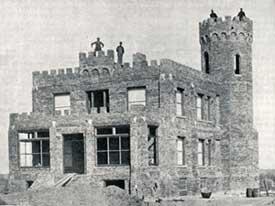
November 1906 saw the laying of a cornerstone for a building that would be named "Bethesda."
On April 18, 1906, Sister Ingeborg Hansen joined the workers at Eben Ezer. Several days after her arrival, however, she fell ill with typhoid. After regaining her health, she joined the other workers where she devoted herself to fifty years of service. She was the first Deaconess Sister to be invested at Eben Ezer and for many years it was her responsibility to supervise the meals and care of elderly residents.
In 1907, Sister Sena Frandsen was welcomed to Eben Ezer as a deaconess candidate. She served the institute for fifty years.
Other events important to the establishment of Eben Ezer in these early years included the arrival of electric power lines in 1908, a second story was added to Nazareth in 1909, which included rooms for hospital care and a small operating room, and in 1912, a wooden bell tower was dedicated. The 575-pound bell was mounted in a tower built from scrap lumber. Mr. and Mrs. H.C. Kjeldgaard donated the money for a gold leaf cross at the top of the tower. As Mr. Kjeldgaard also knew how to do this type of work, he donated his skills to the project as well.
With the efforts of all these people and more, Eben Ezer was established on its permanent site.
The generous donations of the friends of Eben Ezer have always been greatly appreciated and an important part of Eben Ezer's history. Through the many donations, and the help of volunteers in 1914, Eben Ezer was able to reduce patient fees, continue development, and by the end of the year, become debt free.
In the winter months of 1915 and 1916, Eben Ezer was able to build a new center for Christian fellowship. A large room was excavated beneath the annex to Bethesda, a 16×50-foot room that Rev. Madsen called "The Refectory," or common dining room where sixty people could be served at one long table. At mealtime, Pastor Madsen would sit with the brothers and male patients at one end of the table, while Mrs. Madsen sat with the Sisters and women at the other end. Visitors to Eben Ezer were seated accordingly. The project was intended to provide a temporary dining room, but remained in use for meals and meetings for over fifty years.

Rev. Madsen drew the final plans for All Saints Church with the help of a Denver architect named Baerrensen in 1916. The new church was designed as a miniature copy of the thirteenth century Danish Institutional Church. Members of the staff named it "All Saints Church" for several reasons. First, the name honored the people who had contributed to the building fund. Madsen called them "Saints of God." Second, the name was thought to include each "soul the Lord acknowledges as his own." Finally, the All Saints Church would be a "house of prayer for all people." In short, the church was not just for those at Eben Ezer. It was for "all the saints," hence the name "All Saints."
Both exterior and interior walls of All Saints Church were built of coarse, wire cut red brick that closely resembled material used in the churches of Denmark. A gray Del Norte lava stone, cut in a Denver stone yard complimented the red brick.

May, 1924, King Christian X of Denmark surprised everyone at Eben Ezer by awarding the Cross of the Knights of Dannebrog to Pastor Madsen. The King sent the beautiful emblem via the Danish Ambassador in recognition of the excellent work done at Eben Ezer. After Pastor Madsen wore the emblem at the next worship service, he placed it on the altar "with a prayer for God's blessing upon Denmark, its King, its land and people."
In 1927, one of the most familiar landmarks in Brush was erected on the Eben Ezer grounds. A group of people donated the funds for a "more fitting and dignified entrance gate in place of the old picket fence, which had rotted." Baerresen Architects of Denver were again contacted, and the impressive gothic arches were designed for both automobile and foot traffic. Those entering the grounds saw the words "Eben Ezer," while those leaving were reminded by the word "Mizpah" to pray, "May the Lord watch between you and me and when we are absent one from the other" (Genesis 31:49).
During the spring of 1939, the Crown Prince Frederik, and Crown Princess Ingrid of Denmark visited the Eben Ezer grounds. The announcement of their visit was indeed a surprise, but a very welcome one. Plans were made and a celebration was scheduled, and when on April 18, the royal couple stepped from the train, they were treated to a reception of coffee and delicious Danish cookies, baked by the women of the community. The whole event lasted no more than an hour and a half, but to all – and particularly to all who had been born in Denmark – the experience of this short visit was delightful, a memory long to be cherished. To Pastor Madsen this event became the culmination of 35 years of service as his last official act was to introduce the royal guests to the multitude assembled on the lawn.
A few days following the departure of the royal couple, Pastor Madsen and his wife left for a retreat home in the mountains. Besides giving them the permanent use of their apartment at Eben Ezer as long as they live, the Trustees also gave them charge of the Retreat House for as long as they wanted. The Madsens left their work at Eben Ezer as quietly as they had come, but throughout their thirty-five years of service they had a vision of what Eben Ezer could be and in part at least, they had seen it actualized. As it states in one of Eben Ezer's histories, "God had been good. His mercy had not failed and He had granted them to associate with many good and God-fearing men and women as the years had come and gone." Pastor Madsen died some years later on May 29, 1946.

As Elim Hospital developed, it became a very important center for both health care and the education of area doctors. Indeed, in the early 50's, doctors in Northeastern Colorado held quarterly postgraduate clinics for doctors in the area. Held in the Charter House, these meetings provided educational opportunities for doctors in the Brush, Fort Morgan, Akron and other surrounding areas. These meetings brought a considerable amount of notoriety to Eben Ezer and the Elim Hospital, and in 1953 the Eben Ezer Board of Trustees voted to lease the hospital to the Brush Community. This move set the groundwork for what would become the Brush Hospital District, and it freed up Eben Ezer to focus on long term care, which became the focus of its mission and defines a large part of Eben Ezer's responsibilities today.
In 1957, Sister Anna Poulsen was given the task of creating an "occupational therapy" program, a program later known as "recreational therapy." At the time, this was a new field in long term care, and Sister Anna spent hours traveling to other care facilities and studying with several Denver therapists. Her efforts resulted in a pioneering program utilizing crafts and activities designed to increase the activity of the patients and stimulate better physical condition. The result is that occupational therapy became a permanent part of Eben Ezer's care, and pioneered this type of therapy as a part of long-term care in the state of Colorado. In 1994, Eben Ezer began construction of an activity center, which was named the "Sister Anna Poulsen Activities Center" in memory of Sister Anna's work.

Eben Ezer Lutheran Care Center, a trusted name in senior living, is excited to announce the acquisition of four additional assisted living communities in northeast Colorado. This strategic expansion aligns with Eben Ezer's commitment of providing exceptional care, quality services, and a welcoming environment for seniors across the region.
The newly acquired Harmony Home communities, with locations in Fort Morgan, Sterling, and Yuma will operate under the Eben Ezer brand, offering the same high standard of compassionate care and personalized service that has defined Eben Ezer for over one hundred years. With this expansion, Eben Ezer will increase its capacity to serve more individuals while continuing the mission as a progressive, faith-based community providing person centered care and support for the well-being of those we serve.

Eben Ezer will now operate a skilled nursing community, six assisted living buildings, independent living and offering technology in the home for over 250 individuals throughout the northeast Colorado. This acquisition will continue to solidify Eben Ezer's position as a leading provider of senior living and assisted care services in this region of the state.
Our campus has undergone significant campus renovations with a goal to provide nearly everyone a private room, private bathing amenities and increased common space ammentities. There is more renovation to occur but the campus has made significant progress since 2017.
"God had been good. His mercy had not failed and He had granted them to associate with many good and God-fearing men and women as the years had come and gone."
Our mission as a progressive, faith-based community is to provide person-centered care and to support the well-being and growth of those we serve.
Our vision is to empower others and inspire continuous growth.

As a faith-based care center, Eben Ezer seeks to provide comprehensive care to all the neighbors on the campus. Care addresses the “whole” person living and aging well, with dignity and purpose. The spiritual health and needs of our neighbors play a key role in their overall enjoyment regardless of age or changing abilities.
Currently, our chaplain services encompass a part-time chaplain during the week. The Chaplain meets the spiritual and emotional needs of our neighbors through personal one on one visits, group activities, song-fests, and worship services. Our chaplain provides a spiritual assessment upon Admission of all new neighbors to the Care Center. Our goal is to adhere to the philosophy of the Eden Alternative and meet the needs of the whole person, not just provide clinical care.
The Eben Ezer Board of Directors is inclusive of representatives from the Rocky Mountain Synod of the Evangelical Lutheran Church of America and includes members of ELCA clergy. Our Board guides the general control and management of the organization.


122 Hospital Rd, Brush, CO 80723
970.842.2861
800.410.4170
info@ebenezer.org
© 2025 Eben Ezer Lutheran Care Center • All Rights Reserved.